Trigonometric Cheat Sheet
Contents
Trigonometric Values
Trigonometry Table
When performing trigonometry, you will come across a few common angles. Here are a couple tables to help make the computation process faster in these situations.
| Angle | 0 | $\pi/6 = 30^\circ$ | $\pi/4 = 45^\circ$ | $\pi/3 = 60^\circ$ | $\pi/2 = 90^\circ$ | $2\pi/3 = 120^\circ$ | $3\pi/4 = 135^\circ$ | $5\pi/6 = 150^\circ$ | $\pi=180^\circ$ |
|---|---|---|---|---|---|---|---|---|---|
| $\sin$ | $0$ | $1/2$ | $\sqrt{2}/2$ | $\sqrt{3}/2$ | $1$ | $\sqrt{3}/2$ | $\sqrt{2}/2$ | $1/2$ | $0$ |
| $\cos$ | $1$ | $\sqrt{3}/2$ | $\sqrt{2}/2$ | $1/2$ | $0$ | $-1/2$ | $-\sqrt{2}/2$ | $-\sqrt{3}/2$ | $-1$ |
| $\tan$ | $0$ | $\sqrt{3}/3$ | $1$ | $\sqrt{3}$ | $\text{undef}$ | $-\sqrt{3}$ | $-1$ | $-\sqrt{3}/3$ | $0$ |
| $\csc$ | $\text{undef}$ | $2$ | $\sqrt{2}$ | $2\sqrt{3}/3$ | $1$ | $2\sqrt{3}/3$ | $\sqrt{2}$ | $2$ | $\text{undef}$ |
| $\sec$ | $1$ | $2\sqrt{3}/3$ | $\sqrt{2}$ | $2$ | $\text{undef}$ | $-2$ | $-\sqrt{2}$ | $-2\sqrt{3}/3$ | $-1$ |
| $\cot$ | $\text{undef}$ | $\sqrt{3}$ | $1$ | $\sqrt{3}/3$ | $0$ | $-\sqrt{3}/3$ | $-1$ | $-\sqrt{3}$ | $\text{undef}$ |
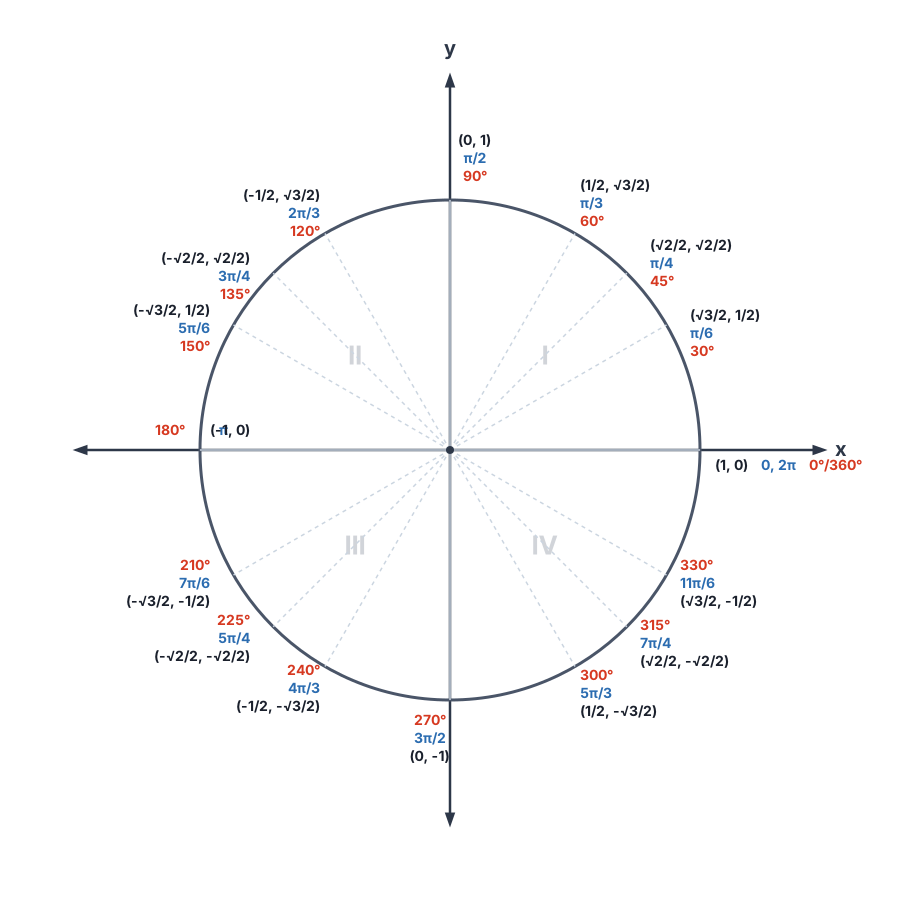
Unit Circle
You can also utilize a Unit Circle, which quickly displays all the angles, trigonometric values, etc. for easy use.
Triangle Identities
There are a lot of relations between the different aspects of side lengths, angle measures, areas, trigonometric functions, etc. that become incredibly useful throughout geometry.
Law of Sines
Law of Sines defines a relationship between side lengths, angles, area, and the radius of the circumscribe circle of the particular triangle. It is expressed as:
$$ \frac{a}{\sin{A}} = \frac{b}{\sin{B}} = \frac{c}{\sin{C}} = 2R $$Where $a$, $b$, and $c$ are the lengths of the sides of a triangle (leg, leg, and hypotenuse, respectively), while A, B, and C are the opposite angles of these sides.
Note that this can be any triangle; it does not have to be a right triangle!
Law of Cosines
Law of Cosines defines an extended version of the Pythagorean theorem which applies for any triangle, not just right triangles. It is expressed as:
$$ \begin{aligned} c^2 &= a^2 + b^2 - 2ab\cos{C} \\ \cos{C} &= \frac{a^2 + b^2 - c^2}{2ab} \end{aligned} $$This is incredibly useful, as it allows you to identify the side lengths of any side of the triangle. From this equation, you can understand the entire geometry of the triangle; its side lengths, interior angles, etc.
Law of Tangents
Law of Tangents is an alternative to the Law of Cosines. It is most often used to solve for the unknown edges of a triangle. It is expressed as:
$$ \frac{a-b}{a+b} = \frac{\tan{\frac{1}{2}(A-B)}}{\tan{\frac{1}{2}(A+B)}} $$Heron’s Formula
You can calculate the area of a triangle (any triangle) using the semi-perimater of the triangle and/or the radius of the circumscribed circle. Depending on what you have handy, you can calculate the area as:
$$ \text{Area} = \sqrt{s(s-a)(s-b)(s-c)} = \frac{abc}{4R} $$Note that the semi-perimeter of a triangle is simply half the perimeter of the triangle, or:
$$ s = \frac{1}{2}(a + b + c) $$An alternative method to calculate the area of a triangle is:
$$ \text{Area} = \frac{1}{2}ab\sin{C} $$Your use of any of these functions depends on the values you have available. Use what you have, then discover what you do not yet know!
Trigonometric Identities
This section covers the various relationships between the trig functions. Many of these identities will come in handy when simplifying equations, so keep them handy!
Pythagorean Identities
There are a few Pythagorean identities that relate the trig functions. They are:
$$ \sin^2{A} + \cos^2{A} = 1 \\ 1 + \tan^2{A} = \sec^2{A} \\ 1 + \cot^2{A} = \csc^2{A} \\ $$Parity
When discussing the parity of the trigonometric functions, it can be seen that cosine and secant are “even” functions, while the others are “odd” functions.
Recall that an even function is one such that an input of a negative value results in a positive value (and the input of a positive value results in a negative value).
However, odd functions are those such that the input of a negative value results in a negative value (and the input of a negative value results in a negative value).
You can see these relationships displayed below:
$$ \begin{aligned} \sin{(-x)} &= -\sin{x} \\ \cos{(-x)} &= \cos{x} \\ \tan{(-x)} &= -\tan{x} \\ \csc{(-x)} &= -\csc{x} \\ \sec{(-x)} &= \sec{x} \\ \cot{(-x)} &= -\cot{x} \\ \end{aligned} $$Period
Trigonometric functions are periodic in nature.
For tangent and cotangent, their behaviors repeat every $\pi$ radians (that is, $180^\circ$).
For the other trigonometric functions, they have a period of $2\pi$ (that is, $360^\circ$).
This means that if you add a multiple of the period to the input of the function, you will get the same result as if it was not added at all! That is:
$$ \begin{aligned} \sin{(x+2k\pi)} &= \sin{x} \\ \cos{(x+2k\pi)} &= \cos{x} \\ \tan{(x+k\pi)} &= \tan{x} \\ \csc{(x+2k\pi)} &= \csc{x} \\ \sec{(x+2k\pi)} &= \sec{x} \\ \cot{(x+k\pi)} &= \cot{x} \\ \end{aligned} $$Sum of Inputs
When input angles are added together, there’s substitutions that can be made!
$$ \begin{aligned} \sin{(x + y)} &= \sin{(x)}\cos{(y)} + \cos{(x)}\sin{(y)} \\ \cos{(x + y)} &= \cos{(x)}\cos{(y)} + \sin{(x)}\sin{(y)} \\ \tan{(x + y)} &= \frac{\tan{(x)} + \tan{(y)}}{1 - \tan{(x)}\tan{(y)}} \\ \end{aligned} $$Difference of Inputs
When input angles are subtracted, there’s similar identities!
$$ \begin{aligned} \sin{(x - y)} &= \sin{(x)}\cos{(y)} - \cos{(x)}\sin{(y)} \\ \cos{(x - y)} &= \cos{(x)}\cos{(y)} - \sin{(x)}\sin{(y)} \\ \tan{(x - y)} &= \frac{\tan{(x)} - \tan{(y)}}{1 + \tan{(x)}\tan{(y)}} \\ \end{aligned} $$Double Angle
The multiplication of 2 in the input of the trig function results in additional identities!
$$ \begin{aligned} \sin{(2x)} &= 2 \sin{x} \cos{x}=(2\tan{x})/(1+\tan^2{x} ) \\ \cos{(2x)} &= \cos^2{x}-\sin^2{x}=2 cos^2x-1=1-2 \sin^2x=(1-\tan^2{x})/(1+\tan^2{x} ) \\ \tan{(2x)} &= (2 \tan{x})/(1-\tan^2{x} ) \\ \end{aligned} $$Euler’s Formula
One relationship between the trig functions, imaginary numbers, and Euler’s constant $e$ are related to Euler's Formula.
$$ \begin{aligned} \sin{x}=\frac{(e^ix-e^(-ix))}{2i} \\ \cos{x}=\frac{(e^ix+e^(-ix))}{2} \\ \tan{x}=\frac{i(e^(-ix)-e^ix )}{(e^ix+e^(-ix) )} \\ \end{aligned} $$