Angles
Contents
Overview
Angles are a particularly important concept in Geometry. Their unique types, units, quirks, and more will be discussed in this section.
Units
Angles are measured commonly by degrees or radians, and uncommonly by gradians.
A Degree is a unit of measuring angles where there is a minimum angle of 0 degrees, and a maximum angle of 360 degrees.
A Radian is a unit of measuring angles where there is a minimum angle of 0 radians, and a maximum angle of $2\pi$ radians.
A Gradian is a unit of measuring angles where there is a minimum angle of 0 gradians, and a maximum angle of 400 gradians.
Essentially, these units are essentially differentiated by what counts as the “maximum” value. Ultimately, degrees and radians are most common, but whichever unit you use, never mix them! You must convert to a single one for your computations to work out properly.
This “maximum angle” is actually dependent upon a flat geometry. Curved geometries (that is, curved spaces) are fundamentally different and will influence the maximum angles possible. Assume a flat geometry unless otherwise noted.
Types of Angles
Angles can be characterized by their size; in other words, the magnitude of the measurement between the two lines, rays, etc.
Describing Single Angles
A Right angle describes a single angle whose measurement is exactly $90^\circ$.
A Acute angle describes a single angle whose measurement is less than $90^\circ$.
A Obtuse angle describes a single angle whose measurement is greater than $90^\circ$.
You may also see the term Reflex Angle, which simply refers to any angle between $180^\circ$ and $360^\circ$.
Describing Multiple Angles
The term Complementary Angles describes two angles such that the sum of their measurements adds up to $90^\circ$.
The term Supplementary Angles describes two angles such that the sum of their measurements adds up to $180^\circ$.
Other Types of Angles
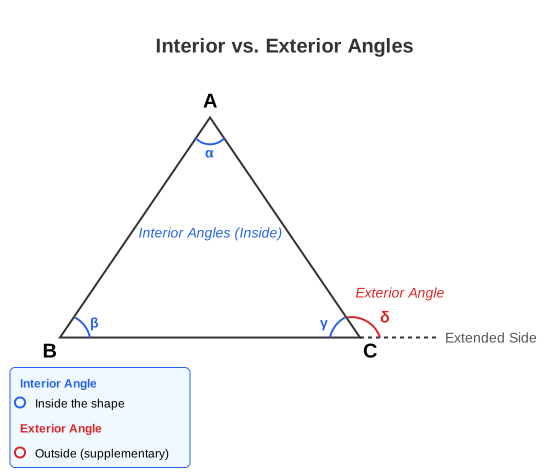
You may also hear about interior and exterior angles. Interior angles reside within a shape, while exterior angles are outside the shape.
Defining an Angle
If you have the line segment $\overline{AB}$ and another segment $\overline{BC}$, then the resulting angle may be defined as: $\angle ABC$.
This is read as “angle A B C”.
Angles are very commonly refered to by the Greek letter “theta”: $\theta$
Standard Position
Angles are often defined and handled in standard position. What this means is you have the following setup:
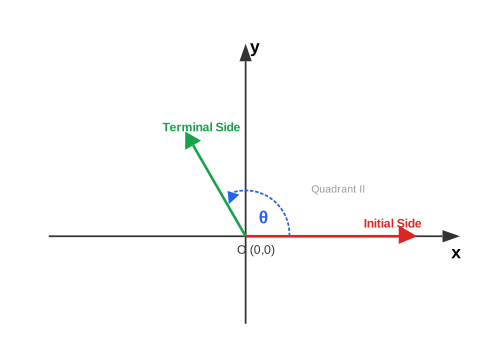
The initial side represents the side that is “fixed”. From this side, the terminal side is “swept out” from the starting point (at the fixed initial side) to the ending point (hence, “terminal” side). The angle, $\theta$, is defined as the angle between the initial side and the terminal side.
Note that the initial side “starts” at the origin $(0, 0)$.
There’s also the coterminal angle, which represents the angle that is opposite of the standard angle. In other words, instead of sweeping counterclockwise from the initial side, the coterminal angle is defined by sweeping clockwise from the initial side.
The coterminal angle is always (assuming flat geometry) $360^\circ - \theta$, where $\theta$ is the terminal angle (the angle in standard position).