Linear Functions
Contents
Linearity
Linear functions describe functions that preserve both additivity and scalar multiplication.
To break this jargon down:
- Additivity: Property of a function where the following holds true: $f(u + v) = f(u) + f(v)$
- Scalar multiplication: Property of a function where the following holds true: $f(cu) = cf(u)$
To think about this much more easily, Linear Functions are functions where the input variable has a degree (that is, exponent value) of 1 (like $f(x)=2x + 2$) or 0 (like $f(x)=2$).
Types
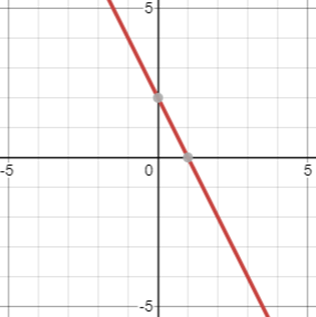
Linear functions present themselves like the following chart. Notice that the graph is just a line (hence, LINEar)
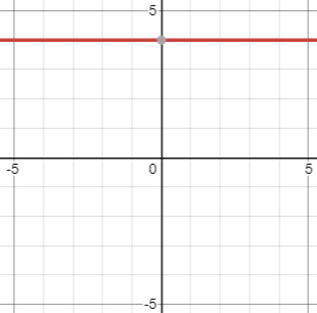
Constant functions are a special type of linear function where, for all output, the output is the same value. These are of the form $f(x) = c$, where $c$ simply represents some numerical value.
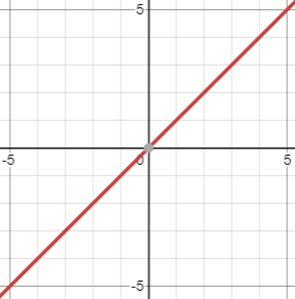
Identity: A special type of linear function where the output is the same as the input. It is of the form, $f(x) = x$.
Forms
Linear functions have important characteristics beyond the preservation of additivity and scalar multiplication.
Linear functions are typically of the form:
$$ y = mx + b $$Where $y$ is the output variable (could be $f(x)$, $g(x)$, $z$, etc.), $x$ is the input variable, and:
- Slope ($m$): The number describing the direction and steepness of the function’s behavior.
- Also known as rate of change.
- A function’s steepness is given by the magnitude of the slope (that is, how big).
- A function’s direction is given by the sign of the slope. That is:
- A positive slope ($m > 0$) means the output grows as the input grows.
- A negative slope ($m < 0$) means the output shrinks (“grows” more negative) as the input grows larger.
- A slope of zero ($m=0$) means the output remains the same no matter the input. That is, this is a constant function!
- Intercept ($b$): The constant number which essentially provides a shift of the function’s values.
- This may also be thought of as the “default” value for $y$, which is the value of $y$ when $x=0$. This is known as the $y$-intercept.
For this reason, the form, $y=mx+b$ is known as slope-intercept form since it describes both the slope and the intercept of a single function.
Another form that may be utilized is the point-slope form, which enables defining a function utilizing two ordered pairs.
$$ y - y_1 = m(x-x_1) $$The first pair is going to be $(x, y)$, as you are defining the behavior between $x$ and $y$. The second pair will be ANY point on the line, represented by $(x_1, y_1)$.
Point-slope form may always be simplified into slope-intercept form, and slope-intercept form may always be expanded into point-slope form (so long as the point chosen resides on the line).
Example:
$$y - 3 = 2(x-4)$$$$y - 3 = 2x - 2(4)$$$$y - 3 = 2x - 8$$$$\boxed{y = 2x - 5}$$Point-slope form is converted to slope-intercept by solving for y!
Slope-intercept form is more open-ended, since you may chose any point. You simply extract the slope and choose a point on the line. For instance: $y = f(x) = 2x - 5$.
Say we choose to utilize $x_1=12$.
First, solve for $f(12)$:
$$y = f(12) = 2(12) - 5 = 24 - 5 = \boxed{19}$$This is your $(x_1, y_1)$ ordered pair. Now, we know that the original slope is 2 (since, in slope intercept form, we have $y = \underline{2}x - 5$). Plug this into the point-slope form template:
$$y - y_1 = m(x - x_1)$$$$y - 19 = 2(x - 12)$$To confirm there are no more mistakes, you can convert it back to slope intercept form, to ensure that the original form is the same as this new form!
$$y - 19 = 2(x - 12)$$$$y - 19 = 2x - 24$$$$\boxed{y = 2x - 5} \; \checkmark$$